
Waste or product? Legal status of fibre waste and recyclates
Anyone working with fibre composite materials knows the situation: after production, during cutting, or at the end of the use phase, material is left behind. The technical question then is: what else can be made from it? The legal question is often even more decisive: is this waste or another product? In practice, it becomes apparent that this point is not clear for companies. Material is frequently declared as waste prematurely because it is unclear at what point the waste status actually arises.
What is considered waste in the production process depends on the objectives of the respective process and the legal criteria. The decisive factor here is the question of when the waste status of recyclates ends and when the product status begins. This is because as soon as a material loses its waste status and is considered a product, waste law no longer applies, but rather product law, which has direct consequences for duties and responsibilities in the value chain [1]. In Germany, the end-of-waste status is regulated in § 5 in conjunction with § 7a of the Circular Economy Act (KrWG) [2].
Terms that make a difference in practice
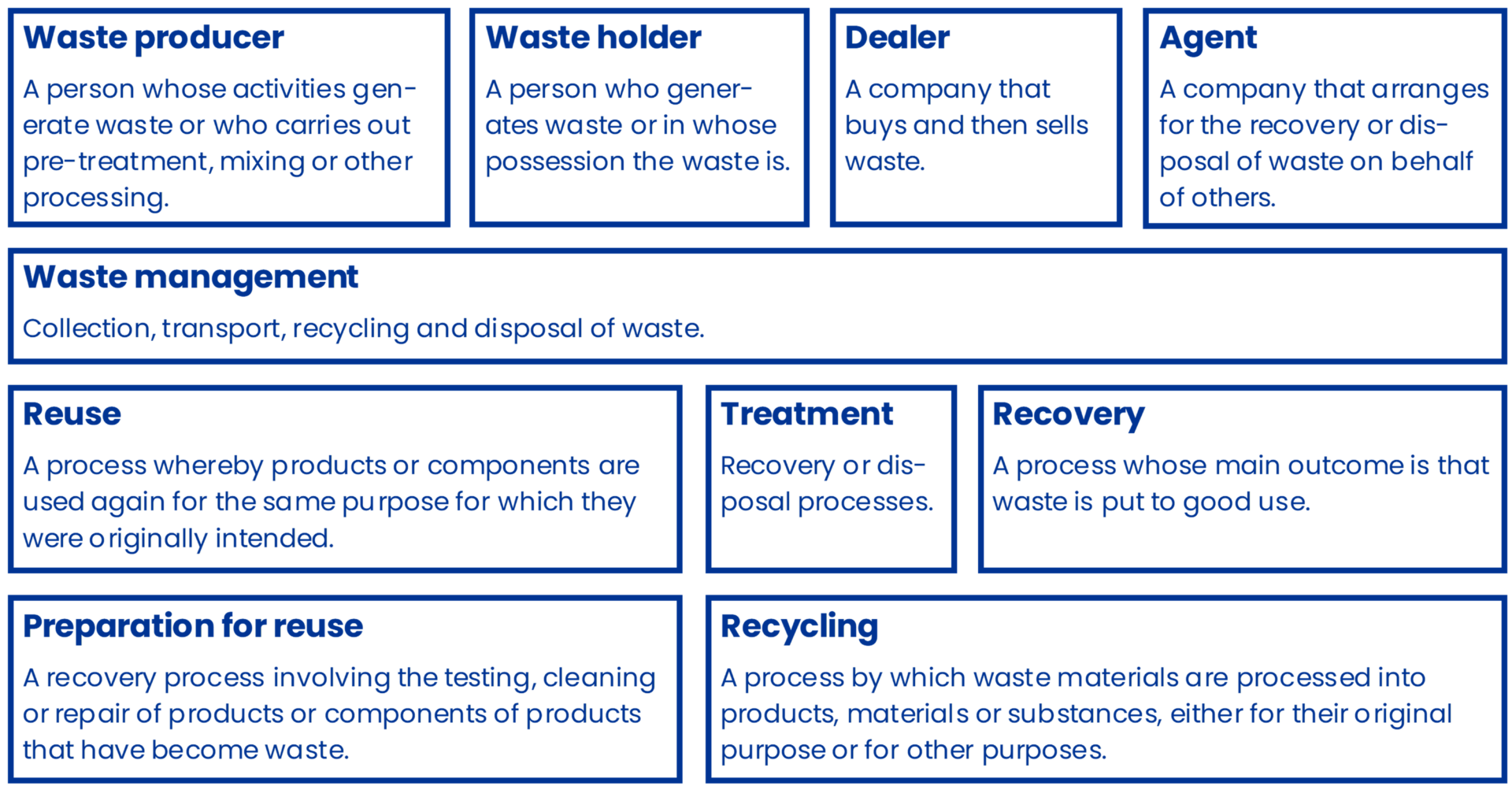
In everyday life, residual materials are often quickly pigeonholed. Legally, however, the situation is more nuanced. The European Commission has laid down guidelines for the interpretation of the Waste Framework Directive (2008/98/EC) in relation to waste and by-products [3]. Thus, individual terms are explained:
In practice, this has serious consequences: how may the material be transported? What requirements apply to storage and treatment? What documentation is necessary? And can the material actually be marketed?
For fibre composite materials, it is often difficult to answer these questions. The reason lies within the material itself. Composites are used in very diverse applications, for example for automotive, aviation, and wind energy industries. They are considered difficult to recycle precisely because of their heterogeneity, especially when thermoset systems are involved [4].
The spectrum of possible paths at the end of life is correspondingly broad. For fibre composite materials, the options range from waste prevention, reuse, and recycling to incineration, co-processing in a cement plant, or, under special conditions, even landfilling. This is exactly why the legal status is so important: it helps determine which path is actually realistic, permissible, and economically meaningful.
From waste law to the market
For companies, the legal status is not a mere formality, but an important management tool. As long as material is considered waste, dealing with it is part of the disposal system. As soon as it can be classified as a product or a marketable recyclate, on the other hand, the focus shifts to quality, specification, delivery capability, and market trust. Especially in the recycling of composites, it becomes apparent that technology and marketing must be considered together. The subsequent use of the recovered material is a central evaluation benchmark for the efforts in the field of recycling.
The pressure is growing
The political and economic pressure on the industry is increasing. Future legislative developments could restrict the use of landfilling and incineration for composite waste even further, which is why alternative solutions are becoming increasingly urgent. At the same time, the transformation of waste into secondary resources is considered a central building block of the resource and circular economy. The actual bottleneck often lies not only in recovery, but also in the question of how the output can once again become a reliable input for new applications.
herefore, the question “waste or product?” should not only be asked at the end. Anyone wishing to collect, process, and market fibre waste must clarify at an early stage what quality is present, how homogeneous the material flow is, what treatment will be necessary, and whether there is a real market for the result. The legal status is thus much more than just a label. It determines how fibre waste can become a raw material, or why exactly this has not yet succeeded..
As of 2026-06-01
List of references
[1] Franke, M., Rieger, T., Hofmann, A., & Fehn, T. (2024). Chemisches Recycling von Kunststoffabfällen – Aktuelle Entwicklungen und Herausforderungen. Österreichische Wasser- und Abfallwirtschaft, 76(9–10), 403–410. https://doi.org/10.1007/s00506-024-01062-3
[2] Bundesrepublik Deutschland. (2012). Gesetz zur Förderung der Kreislaufwirtschaft und Sicherung der umweltverträglichen Bewirtschaftung von Abfällen (Kreislaufwirtschaftsgesetz—KrWG). https://www.gesetze-im-internet.de/krwg/BJNR021210012.html
[3] Europäische Union. (2025). Richtlinie 2008/98/EG des Europäischen Parlaments und des Rates vom 19. November 2008 über Abfälle und zur Aufhebung bestimmter Richtlinien (konsolidierte Fassung vom 16. Oktober 2025). https://eur-lex.europa.eu/legal-content/DE/TXT/HTML/?uri=CELEX:02008L0098-20251016
[4] Yang, Y., Boom, R., Irion, B., Van Heerden, D.-J., Kuiper, P., & De Wit, H. (2012). Recycling of composite materials. Chemical Engineering and Processing: Process Intensification, 51, 53–68. https://doi.org/10.1016/j.cep.2011.09.007
About the partnership
Be part of the alliance and join us in facing the challenges with regard to the no longer avoidable handling of fibre composites. Let us together lead the region “Elbe Valley Saxony” into an economically resilient future.