

Circular economy and resource management: thinking them together!

The terms “circular economy” and “resource management” are appearing more and more often in policy strategies, corporate goals, and public debate. But what exactly do they mean? And are circular economy and resource management actually the same thing, or two different concepts that simply resemble each other?
One thing is clear: in a world with finite resources and growing amounts of waste, we can no longer afford to use materials just once and then dispose of them. This challenge becomes especially apparent for fiber-reinforced composites such as carbon and glass fibers in construction, aviation, or vehicle engineering.
From linear to circular use
At the EU level, linear systems still dominate [1]. This is precisely where the circular economy comes in. Its goal is to keep materials in the economic cycle for as long as possible. This is done through strategies such as reuse, repair, remanufacturing, and high-quality recycling. In carbon concrete construction, components made from fiber-reinforced composites conserve material and can be better integrated into resource-efficient, circular value chains [2].
Resource management as strategic framework
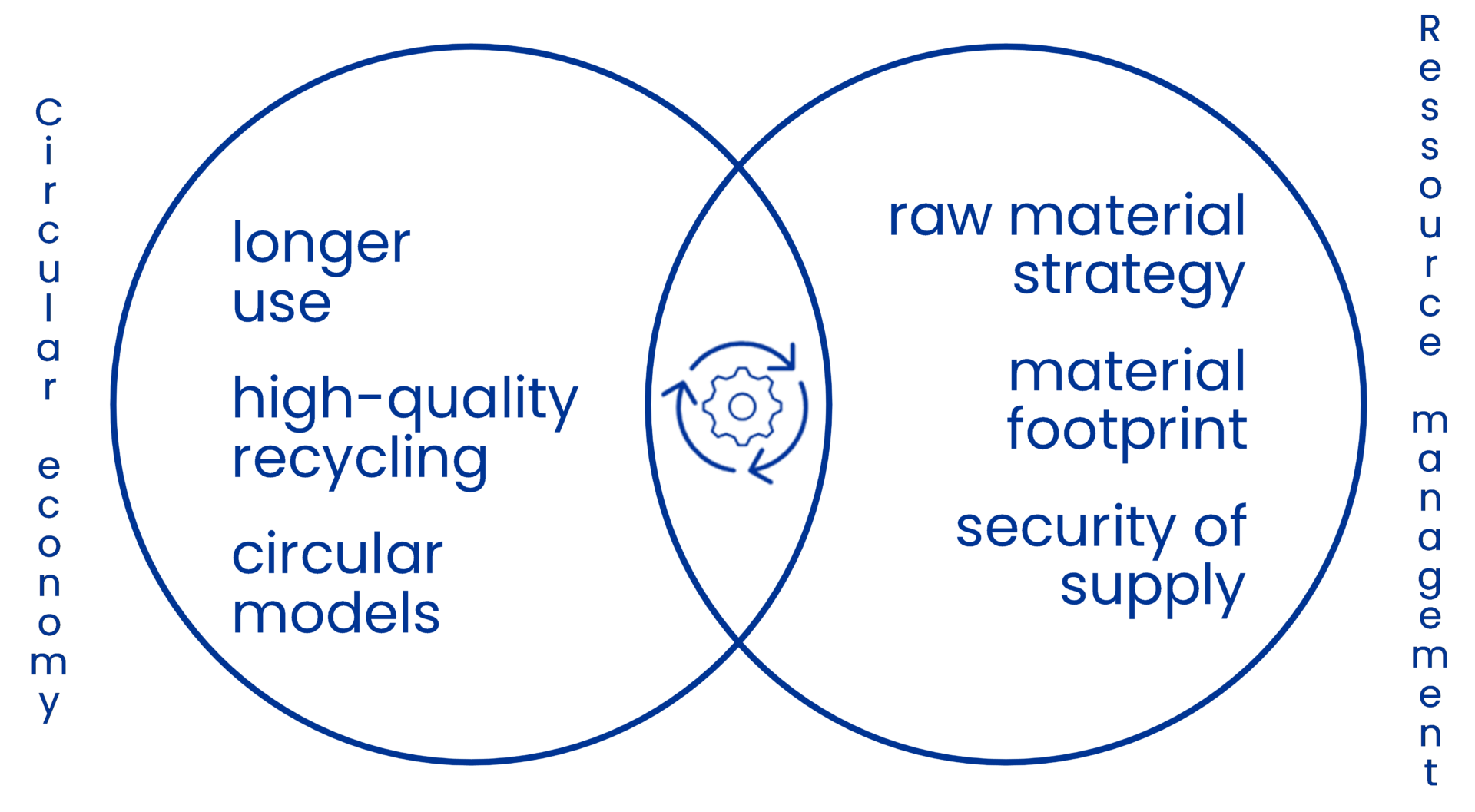
While the circular economy primarily describes how we keep materials within the system, the resource management poses the overarching question: which resources do we use, in what quantities, and with what long-term consequences?
Resource management includes, among other things:
- the selection of raw materials used (e.g. critical raw materials, regional availability),
- efficiency in handling these materials over the entire life cycle,
- the assessment of environmental impacts along the value chain,
- as well as questions of resource dependency and supply security.
Sustainable resource management not only helps to reduce environmental impacts, but also opens up economic opportunities, for example through lower import dependency and the creation of jobs in circular-oriented sectors [3]. These in turn include the recycling and reprocessing of fiber-reinforced composites, where new technologies and business models are emerging.
Circular economy and resource management: two sides of the same coin
Circular economy and resource management are therefore not identical, but closely linked. They can be understood as two perspectives on the same subject:
- Resource management looks at the big picture. It analyzes material flows, resource use, and environmental impacts at the system level.
- Circular economy develops concrete strategies and solutions to close these material flows and reduce resource consumption.
Only in combination do both approaches unfold their full impact. A circular economy that focuses only on recycling at the end of use falls short if the choice and quantity of resources used are not questioned at the same time. Conversely, a resource strategy remains abstract if it is not implemented through practical circular solutions, for example in product design or waste management.
Why thinking them together is so important
For fiber-containing materials, this means: from the design of components to the use phase and on to reprocessing, circular economy and resource management must be thought together. Only then can the valuable properties of fiber-based materials be fully realized in the long term, without placing excessive burdens on the necessary raw materials and the environment.
Circular economy and resource management are therefore not just a passing trend, but a central element of a future-proof industry. They are key to whether we succeed in keeping materials such as fiber-reinforced composites in closed loops and thus combine ecological responsibility with economic stability.
As of 2025-12-01
List of references
[1] European Environment Agency. (2024). Europe’s circular economy in facts and figures. Briefing. URL: https://www.eea.europa.eu/en/analysis/publications/europes-circular-economy-in-facts
[2] Kortmann, J., & Minar, S. (2023). Contribution of carbon concrete construction to the circular and resource economy. Buildings, 13(11), 2851. https://doi.org/10.3390/buildings13112851
[3] European Environment Agency. (2024). Accelerating the circular economy in Europe – State and outlook 2024. Publications Office of the European Union. URL: https://www.eea.europa.eu/publications/accelerating-the-circular-economy
About the partnership
Be part of the alliance and join us in facing the challenges with regard to the no longer avoidable handling of fibre composites. Let us together lead the region “Elbe Valley Saxony” into an economically resilient future.